rehearsing the future
排練未來
2022-
writing
A series of reported essays for In These Times, commissioned and edited by Sherrell Barbee, part of an ongoing longer-form work.
2022-
寫作
一系列發表於 In These Times 的報導性文章,由 Sherrell Barbee 委託與編輯,現正發展為一個更長篇的創作計畫。
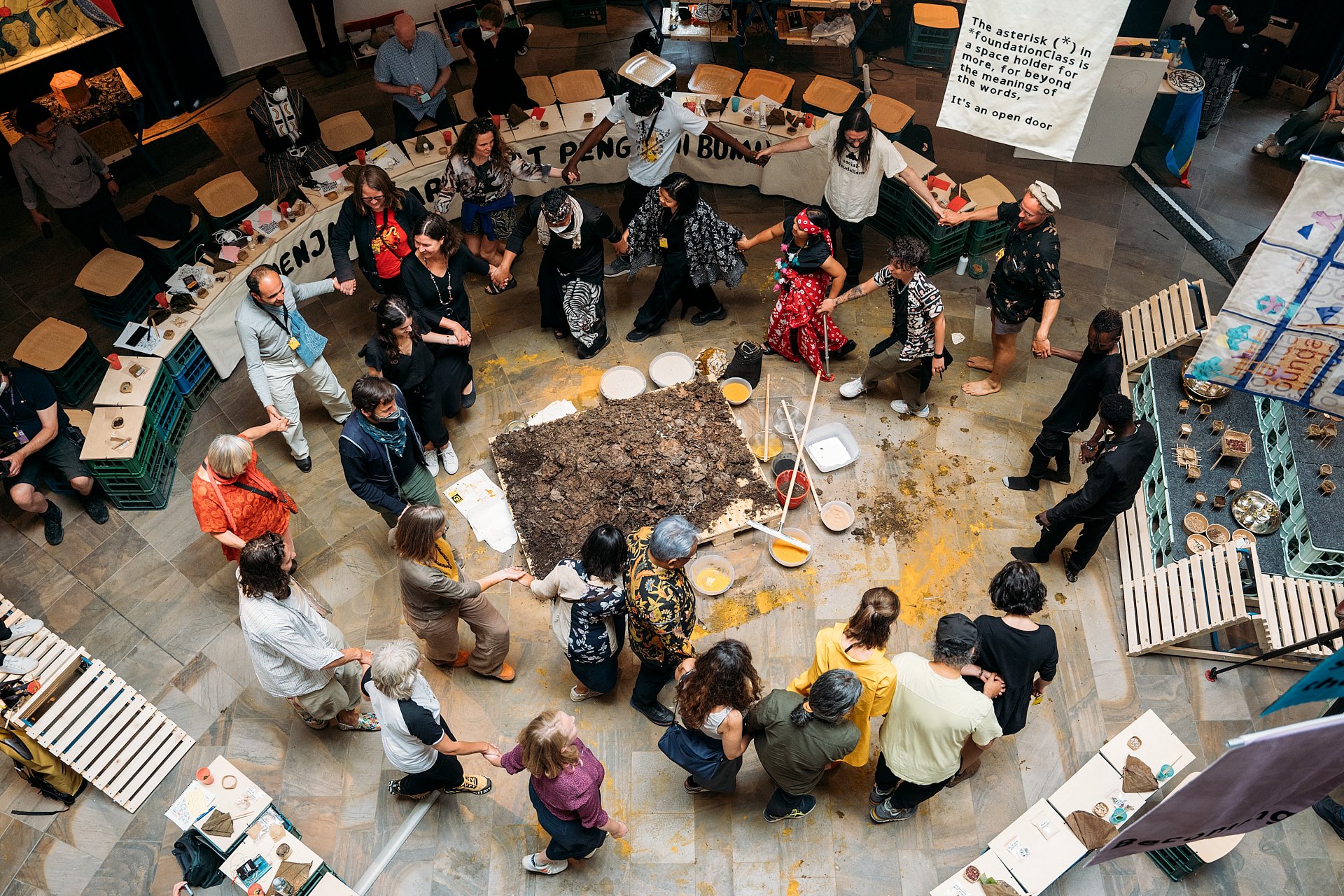
The New Rural Agenda Summit at documenta fifteen, hosted by Jatiwangi art Factory. Kassel, Germany, 2022. (Credit: Martha Friedel)
A well-known critic said it plainly: “NGO aesthetics.”
We were at a socialism conference, in a room committed to imagining alternatives. The phrase was a dismissal: amateur work, not worth seeing. I thought about where that reflex came from—an aesthetic shaped by American Cold War efforts, where political art was recast as crude and unserious.
Weeks later, I went to Kassel anyway.
A banner stretched across the wall: children at play, farmers in the fields. I inched closer, translating fragments on my phone: “who cares about the events of peace and war.” As my eyes moved across the drawing, the scene shifted. Faces contorted, hands rose to shield what was coming. Tanks rolled in beside UN vehicles. A poster of George W. Bush hovered over a pile of skulls. And beneath it all, an open-mouthed figure—the infinite scream I could not turn away from. The images did not resolve into metaphor or reach toward abstraction. They held where they were: in violence and memory, refusing to turn suffering into something to contemplate.
Across ruangrupa’s documenta 15, art collectives had reorganized the exhibition itself: resources pooled, authorship distributed, space opened to those long excluded from its centre. Most artists were of and living among the global majority, without gallery representation, and without diasporic translators to render their work legible to Western art discourse. This was not art as ornament or gesture.
What emerged was lumbung, a shared infrastructure of resources, authorship, and care: communal kitchens, assemblies, bodies huddled over fire, food passed hand to hand, dancing late into the night. Through it, new worlds—beyond the machinery of plunder, where life is not reduced to mere survival—were being imagined and practiced into being.
***
In Bengaluru, I sat in a room where art was being asked to justify itself in policy terms: Who did it reach? What did it change? How do we know? The group wrestled in earnest, but the terms were already set: those who “make real change” carried more weight.
The demand to extract “impact” narrows what could be known, admitting only what could be counted and casting aside what could not be captured in data: wonder, grief, longing, joy, tenderness, spirit, solidarity, the sacred.
Later, I spent time with the artist Indu Antony at Namma Katte, a small women’s center where women could rest and simply be together, often for the first time. In one work, she had brought together grandmothers to perform oppari, a traditional Tamil mourning song. At first, they sang as they always had: praise for the dead, lament for their passing. But as the names and stories of murdered local women were sung, something shifted. The songs broke open.
“You brother’s wife, what a heartless traitor she has to be to push you off a building when you were pregnant. Oh my dear, what pain that unborn child must have suffered! It doesn’t matter how many temples I go to, this pain will always stay within me.”
Grief moved from performance into the body, from past into present. Women wept for their daughters, for their neighbours, for themselves.
“In the land I was born, I don’t have anything to call mine. I have no joy to call mine.”
They sang until something else gathered in the room, something that resisted being measured, something that could no longer be contained.
What arises when grief is fully felt?
What is possible when mourning is set loose?
***
I landed in Berlin on October 8, 2023, for a conference on transnational solidarity, and watched “never again” mobilized to justify the sacrifice of Palestinians. Those who had built their careers theorizing solidarity struggled to practice it when the stakes actually mattered.
Days later, I arrived in London to a different kind of space. The Rehearsing Freedoms Festival gathered communities long pushed to the margins—people of colour, queer and disabled communities—to build and practice radical care. Politicized tai chi, collective rest, elders’ circles, community meals, support spaces for those living through ongoing violence.
The emphasis on practice drew from Black radical traditions of improvisation, what Fred Moten describes as learning, together, how to move within uncertainty. Here, solidarity was neither theory nor posture nor performance, but something inhabited and enacted.
***
Each time the world closes in—war, genocide, the grind of systems that ask us to accept less—I find myself returning to these sites where other ways of being can be held and embodied. Where different ways of sensing, of relating, of acting together are rehearsed in real time.
These practices may be small in scale, but they are not peripheral—they are the ground from which revolution grows.
一位知名評論者說得很直接:「NGO 美學。」
那是在一場社會主義會議上,一個聲稱要想像替代方案的空間。這句話帶著預設的否定——業餘、不值得看。我不禁想,這樣的反應從哪裡來?那是一種在美國冷戰時期被塑造出來的美學,在那裡,帶有政治性的藝術被重新定義為粗糙、不成熟。
幾週後,我還是去了卡塞爾。
一幅畫橫跨整面牆:孩子在玩,農人在田裡勞動。我慢慢靠近,用手機翻譯畫上的字:「誰在乎和平與戰爭的種種事件?」隨著視線移動,畫面開始變形。臉孔扭曲,雙手抬起試圖遮擋即將到來的一切。坦克與聯合國車輛並行前進。一張喬治・布希的海報懸在一堆骷髏上方。而在這一切之下,一個張開嘴的身影——一聲我無法移開目光的、沒有盡頭的尖叫。
這些影像沒有被轉化成隱喻,也沒有走向抽象。它們就停在那裡:在暴力之中,在記憶之中,不讓苦難變成一種可以被安靜觀看的東西。
在 ruangrupa 策劃的卡塞爾文件展 documenta 15 裡,藝術集體重新安排了整個展覽:資源被共享,作者不再屬於個人,空間向那些長期被排除的人打開。多數藝術家來自、也生活在全球多數世界,沒有畫廊代理,也沒有替他們把作品翻譯進西方藝術語言的人。這不是裝飾,也不是一種姿態。
出現的是「lumbung」——一種共享資源與照顧彼此的方式:公共廚房、一起開會、圍著火堆坐著的身體、手傳手的食物、一直持續到深夜的舞動。在這之中,一些新的世界開始被想像,也開始被練習出來——在掠奪的機器之外,在生命不被壓縮成只剩生存的地方。
***
在班加羅爾,我坐在一個房間裡,藝術被要求用政策的語言為自己辯護:它觸及了誰?帶來了什麼改變?我們怎麼知道?大家很認真地討論,但前提其實已經決定了——那些「真正帶來改變」的人,聲音更大。
對「影響力」的要求,縮小了可以被理解的範圍。只有能被量化的才算數,其他的都被排除在外——那些無法變成數據的經驗。
之後,我和藝術家 Indu Antony 在 Namma Katte 相處——那是一個小小的女性空間,女人可以在那裡休息、待著、只是彼此在一起,對很多人來說,這是第一次。在她的一件作品裡,她邀請祖母們一起唱 oppari,一種泰米爾的傳統哀歌。一開始,她們照平常的方式唱:讚頌逝者,哀悼離去。但當在地被殺害女性的名字與故事被唱出來時,有些東西改變了。歌聲裂開了。
「你哥哥的妻子,她怎麼可以這麼狠心,把你在懷孕的時候推下樓?我的孩子啊……那個還沒出生的孩子承受了多大的痛苦。就算我走遍多少座廟,這個痛都會一直留在我裡面。」
悲傷從表演進入身體,從過去流到現在。女人們為女兒、為鄰居、也為自己哭。
「在我出生的地方,我沒有任何東西可以說是我的。我沒有任何快樂是屬於我的。」
她們一直唱,直到房間裡出現了另一種東西——一種不再能被測量,也不再能被收住的東西。
當悲傷真的被感受到,會發生什麼?
當哀悼被放開,會帶出什麼?
***
2023 年 10 月 8 日,我抵達柏林,參加一場關於跨國團結的會議。我看見「不再重演」這句話,被用來合理化對巴勒斯坦人的犧牲。那些以團結為研究與職業的人,在真正關鍵的時刻,卻無法實踐它。
幾天後,我在倫敦進入了一個完全不同的空間。Rehearsing Freedoms 藝術節把長期被推到邊緣的人帶到一起——有色人種、酷兒、身心障礙者——一起練習照顧彼此。有人一起動、一起休息、一起吃飯、一起待著。那不是在談「照顧」,而是在做。
這種對「練習」的重視,來自黑人民族解放傳統中的即興精神。正如 Fred Moten 所說,那是一種在不確定中,一起學習怎麼移動的方式。在這裡,團結不是立場、不是姿態,也不是表演,而是一種被活出來的東西。
***
每當世界一步步收緊——戰爭、種族滅絕,以及那些要我們習慣接受更少的體制——我總會回到這些地方。在這裡,其他的生活方式還能被承接、被活出來。不同的感受方式、關係方式、一起行動的方式,在這裡被一點一點練習。
這些實踐或許規模不大,但並非邊緣——它們正是革命生長的土壤。