what we owe those not yet here
為尚未到來之人的承擔
2023-2024
facilitation
A gathering co-designed and co-held with 7Generation Cities, Mi’kmaw Native Friendship Centre, Dark Matter Labs, and Community Foundations Canada, alongside leaders Tanya Chung-Tiam-Fook, Jayne Engle, and Pamela Glode-Desrochers.
2023-2024
引導
與 7Generation Cities、Mi’kmaw Native Friendship Centre、Dark Matter Labs、Community Foundations Canada 共同設計與共同承載,在 Tanya Chung-Tiam-Fook、Jayne Engle、Pamela Glode-Desrochers 的領導下協作完成。
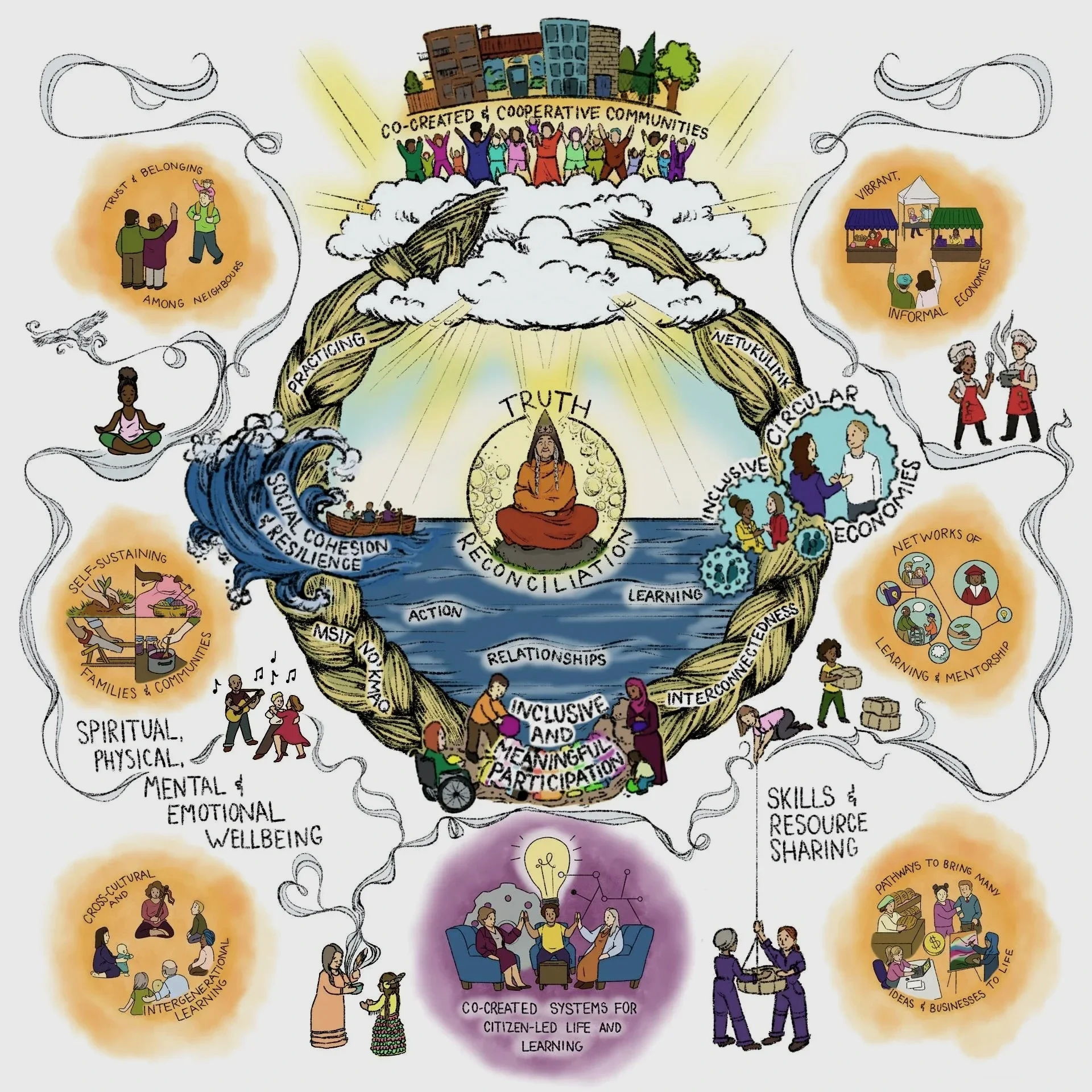
The Circle of Change from Every One Every Day, an initiative of the Mi’kmaw Native Friendship Centre, illustrates a cycle that flows continuously and reminds us that if we put out good energy, it will come back to us. Nukumi, the grandmother of Kluscap (a cultural hero of the Mi’kmaq), is placed at the centre, signifying the Indigenous knowledge and wisdom needed to surface truth and centre our work in the process of reconciliation and healing. // Mi’kmaw Native Friendship Centre 所推動的「Every One Every Day」計畫中的「改變之圈」,描繪了一個持續流動的循環,提醒我們:當我們釋出善的能量,它也會回到我們身上。在這個圓的中心,是 Nukumi——Kluscap(米克馬族的文化英雄)的祖母。她的位置象徵著原住民族的知識與智慧,是讓真相得以浮現,並在和解與療癒的過程中,指引我們如何將工作扎根其中的核心力量。
We sat in a circle inside a converted industrial space in Toronto. Outside, the city carried on. Inside, Indigenous leaders, municipal staff, and organizers from across Canada strategized around land rematriation.
Not in principle, but in practice. At scale.
The gathering was held with responsibility to those not yet here—thinking in seven generations, rooted in Haudenosaunee teachings that ask us to consider those who came before and those who will come after.
Again and again, the conversation returned to the same question: What does it mean to try to build decolonial futures through institutions designed to contain them?
Many in the room were already working inside city governments or alongside them: drafting reconciliation action plans, trying to establish Indigenous land trusts, pushing for meaningful co-governance. Eight years after Canada’s Truth and Reconciliation Commission released its final report, much had been named, but change kept stalling where it required a redistribution of power.
The constraints were familiar: Jurisdictional limits. Funding tied to unrealistic timelines and measurable outputs. Indigenous knowledge brought in, consulted, cited, and moved past. One leader spoke about his people being treated as an extractable commodity: knowledge taken in transactional ways, rather than held as something with its own integrity. Indigenous washing, he said, chips away at agency and hope within our communities. The room needed a breath after that.
Over forest tea and honey harvested on site, Elder Catherine Tàmmaro shared teachings from Anishinaabe and Wendat stewards—ways of relating to land, time, and responsibility that did not fit easily within the structures we’d been naming.
I was honoured to have been invited to help steward this gathering, oriented around how we embed Truth and Reconciliation into the civic life and structure of Canadian cities. At times that meant slowing the room down, and letting a question stay open rather than moving too quickly to solution. At others, it meant noticing when the conversation narrowed into what institutions could accommodate, and easing it back toward what people were actually trying to build.
There were many questions we could not answer: What does repair mean while harm continues? Is it even possible to make colonial systems more relational and consensual? How do we begin to loosen the logics of extraction and scarcity that shape how decisions are made, and move toward systems of abundance and generosity?
We did not leave with agreement on what repair would look like—only the sense that it could not be contained within existing structures, and that, for now, the work continues through them, carried by those who keep pressing at their edges, drawing from ways of being that have long held what these systems cannot.
我們圍坐在多倫多一處改造過的工業空間裡。外頭,城市照常運轉;裡面,來自加拿大各地的原住民族領袖、市政工作者與行動者,正一同討論土地回歸(land rematriation)。
不是停留在原則,而是落在實踐。
這場聚會以對尚未到來之人的責任為出發——一種「七代思維」,源自豪登諾索尼(Haudenosaunee)的教導,提醒我們在做決定時,同時思考祖先與未來世代。
一次又一次,討論回到同一個問題:當制度本身就是為了收編與限制而設,我們該如何在其中嘗試建構去殖民的未來?
在場許多人早已在市政體系內,或與之密切合作——撰寫和解行動計畫、推動土地回歸相關工作、嘗試建立共同治理,但往往停留在諮詢層級。距離加拿大真相與和解委員會最終報告發布已八年,許多傷害已被揭示、被命名,但一旦觸及權力的重新分配,改變便反覆停滯。
這些限制並不陌生:管轄權的界線、被壓縮的時程與可量化的績效要求、原住民族知識被納入體制——被諮詢、被引用,卻很快被略過。一位領袖談到,他的族人如何被視為可被提取的資源:知識以交易的方式被取用,而非被視為本身即具有完整性與價值的存在。他說,「原住民漂白」(Indigenous washing)正一點一滴侵蝕社群的能動性與希望。那一刻,整個空間需要暫停一下。
在現場採集的森林茶與蜂蜜之間,長者 Catherine Tàmmaro 分享來自 Anishinaabe 與 Wendat 傳承者的教導——一種關於土地、時間與責任的關係方式,難以被我們剛剛所討論的制度架構所容納。
我受邀共同設計並承載這場聚會,嘗試在過程中撐開一個空間,讓「真相與和解」能夠被帶入加拿大城市的公民生活與制度之中。有時,這意味著放慢節奏,讓問題得以停留,而不急於走向解方;有時,則是察覺討論何時被收束進制度可理解的範圍,再將它帶回人們真正試圖建構的方向。
有些問題,我們仍無法回答:當傷害仍在持續,修復意味著什麼?在殖民體制之中,是否可能建立更具關係性與共識的運作方式?我們該如何鬆動深植於決策之中的抽取與匱乏邏輯,轉向其他可能?
我們並未帶著對「修復」的共識離開——只有一種感覺:它無法被既有制度所容納。而在此刻,這項工作仍必須穿行其中,由那些持續在邊界施力的人承接與推動,並從那些長久以來已能承載制度所無法承載之物的生活方式中汲取方向。